Curiosity is often the spark for creative inspiration, especially when a story captures worldwide attention. Julia Quinn’s “Bridgerton” series stands out as a rare combination of romance, history, and charm that feels both timeless and contemporary. Many classic works leave readers guessing about their origins, but Quinn has revealed how her ideas developed.
Her journey reflects a mix of early influences, personal experiences, and unexpected moments that gradually formed the “Bridgerton” world.
A Love for Books That Started Early
Quinn’s love for storytelling started in childhood. Surrounded by books at home, she read serious classics like “Crime and Punishment” and “Heart of Darkness,” yet she was drawn to romance novels.
She enjoyed lighter, relationship-focused series. At first, she claimed her reading was research for writing her own stories, but that soon became reality. Writing evolved into a lifelong passion.
While at Harvard, a small yet pivotal moment encouraged her. One evening, reading a romance novel while eating ice cream, she decided to try a full-length novel herself, marking the start of her professional journey.
The Path That Led to “Bridgerton”
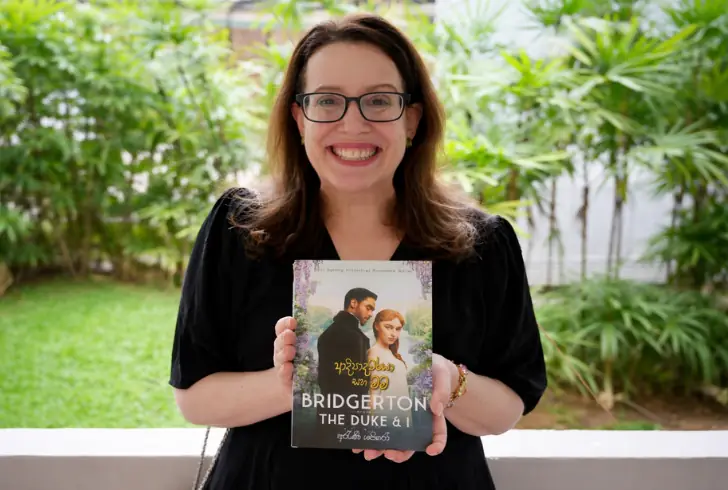
Although Quinn loved writing, she initially pursued a different career. After graduating, she enrolled in Yale Medical School with plans to become a doctor. During that time, her creative side continued to grow, and eventually, writing took priority.
A key moment came when she met a fellow student who struggled with a severe stutter. That encounter later shaped one of her most memorable characters, Simon Basset, the Duke of Hastings, in “The Duke and I.”
Quinn explained that she designed Simon’s difficult upbringing with intention, then created the warm Bridgerton family as a strong contrast. She wanted to place him in a world that offered support, connection, and love.
This contrast between hardship and belonging became one of the emotional anchors of the series.
Why the Regency Era Felt Right
Quinn chose the Regency period as the backdrop for “Bridgerton,” and that decision played a major role in the series’ appeal. She described the era as distant enough to feel magical, yet close enough to remain relatable. Social behaviors, emotions, and relationships still reflect modern experiences, which helps readers connect easily with the characters.
Quinn initially envisioned a short series centered on a few Bridgerton siblings. Over time, the story expanded naturally. Each new character added depth, making the family dynamic more intricate with every book.
Interestingly, Quinn admitted she doesn’t remember exactly how the Bridgerton family first came to mind. She later reflected that the original story began in the late 1990s, giving the series a sense of long evolution rather than a sudden idea.
The Creation of Lady Whistledown

While the origins of some “Bridgerton” elements are unclear, Quinn clearly recalls Lady Whistledown’s conception. She wanted a way to convey background information without forcing unnatural dialogue. A gossip writer was the perfect solution.
She explained that a society columnist could relay key details smoothly while adding humor and intrigue. Lady Whistledown quickly became one of the series’ most distinctive characters.
Quinn described her as clever, observant, and entertaining without cruelty, helping to shape the tone of the novels.
Though “Bridgerton” leans heavily on romance, historical figures such as Queen Charlotte and King George III influenced parts of the story, lending the series a sense of authenticity.
In an unusual move, Quinn later wrote a novel inspired by “Queen Charlotte: A Bridgerton Story,” which had first appeared as a television series. This reverse adaptation highlights the franchise’s cultural significance.
Romance Fiction and Its Cultural Value
Quinn has never stopped advocating for romance novels. She points out that stories written mainly by and for women often don’t get the credit they deserve.
Her argument is simple: these books matter. They reach readers on a deep emotional level, and “Bridgerton” is proof of that.
Her journey shows that creative sparks can come from anywhere. Early reading, personal experiences, and problem-solving all shaped her work.
The stories are warm, historically informed, and emotionally engaging. Bridgerton’s beginnings reflect hard work and a love for storytelling.